Why DealWatch is not just another generic price tracker
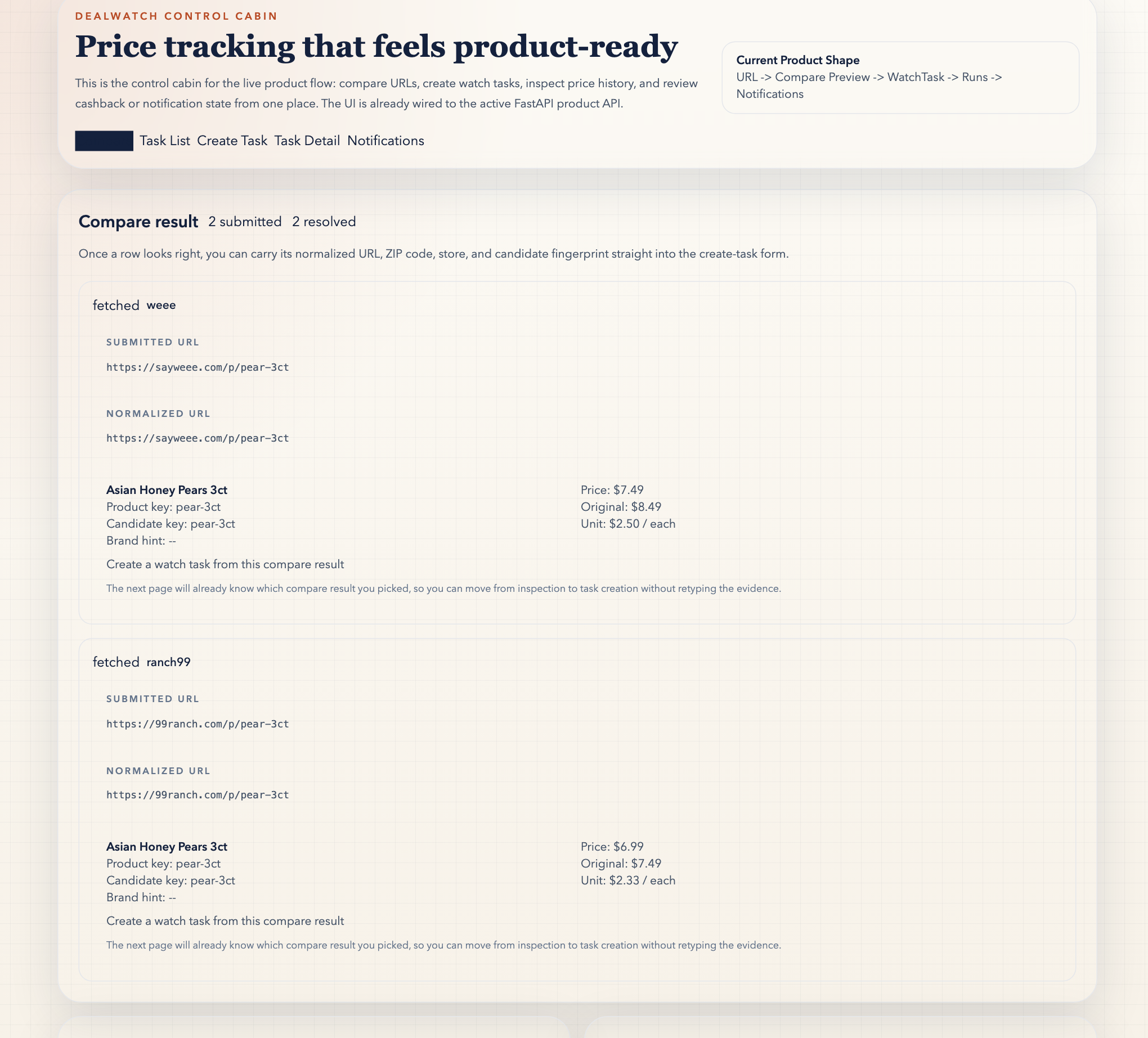
A generic price tracker starts after you pick one link. DealWatch starts earlier: compare candidate URLs first, keep cross-store context alive, and only then carry the right candidate into longer-lived watch state. DealWatch is not just another single-link tracker.
AI-assisted explanation stays on top of deterministic evidence. These public pages are read-only proof surfaces, not hosted automation.
Generic tracker
You paste one link, hope it is the right target, and only then discover whether the long-lived record is worth keeping.
DealWatch
You compare multiple URLs first, inspect normalized candidates, score inputs, and why-like / why-unlike reasons, then either create a single watch task or keep the candidates alive inside a compare-aware watch group.
Feature comparison
This is the shortest truthful way to explain why DealWatch is product-shaped instead of just scraper-shaped.
| Capability | Generic price tracker | DealWatch |
|---|---|---|
| Before-task validation | No real intake stage | Compare Preview checks candidate URLs first |
| Cross-store comparison | Usually manual and off to the side | Built into the first product step |
| Long-lived compare context | Usually disappears after you pick one link | Can stay alive inside compare-aware watch groups |
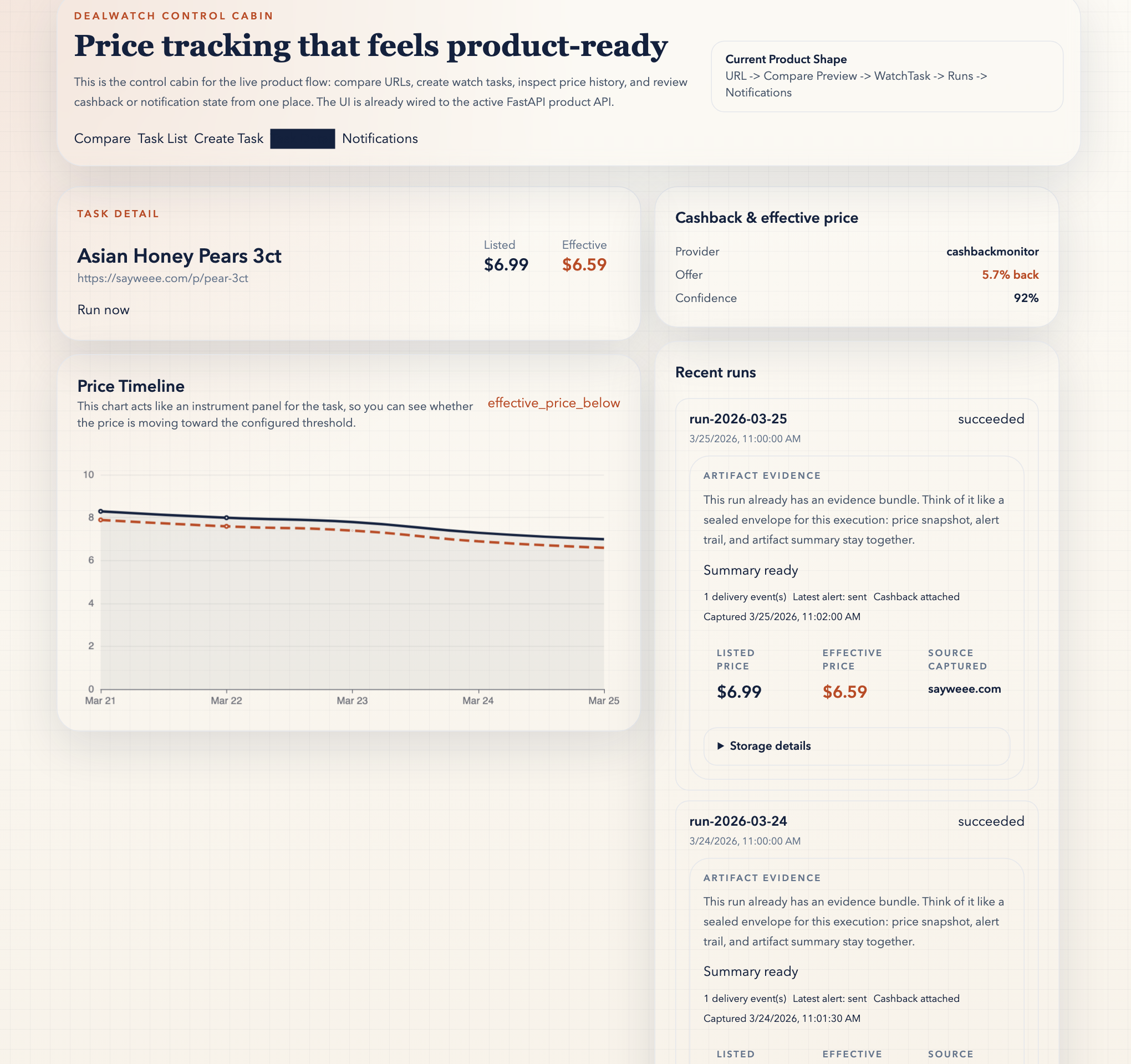
| Effective price | Often listed price only | Cashback-aware effective price is part of the task loop |
| Run evidence | Often invisible | Runs, price history, health, and delivery events are visible in the UI |
| Public trust surface | Often README-only | README, releases, Pages, discussions, and proof-driven repository guards all align |
| Builder-facing truth surface | Usually no honest MCP/API story, or only a thin README mention | Read-only MCP/API surfaces plus the builder starter pack can already be consumed by Claude Code, Codex, OpenHands, OpenCode, OpenClaw, and similar agent clients without pretending write-side automation is ready |
| First-run learning curve | Often install first, understand later | Public `Comparison`, `Compare Preview`, and `Proof` pages let you grasp the product before local setup |
Why builders and AI tool users care
If you are wiring Claude Code, Codex, OpenHands, OpenCode, OpenClaw, or another MCP/API client, this product shape matters because DealWatch exposes truth after compare, not before it.
Compare before automation
The safest builder loop starts with Compare Preview and read-only inspection. It does not assume every submitted link should immediately become durable product state.
AI assists explanation, not truth
The AI layer helps explain compare, watch-group, and recovery decisions, but deterministic product truth still owns the final state and evidence.
Real read-only builder surfaces
The current MCP/API layer plus the builder starter pack already give Claude Code, Codex, OpenHands, OpenCode, OpenClaw, and similar clients a safe observation window without pretending write-side operator automation is complete.
The product proof
The argument is not just words. The screenshots and visual proof exist because the product flow is real and already wired.