Use this route after the product story is already clear. Read the builder pack and phase-1 contract first, then use the static catalog, starters, pack, and bundle mirrors as the machine-readable version of the same route before you switch to local runtime exports.
Human path first: builder pack, contract, then runtime. If you still need the product pitch or the evidence trail, go back to Compare Preview and Proof first. Native Claude/Codex bundle candidates and listing-prep inputs only come after the route is clear. Public proof is intentionally mixed: PyPI and the Official MCP Registry are live, while OpenClaw still lacks fresh public ClawHub listing proof, OpenHands is closed and unmerged, and MCP.so still waits on host acceptance.
Both paths still stop at the same read-only, local-first boundary. No hosted control plane, no write-side MCP promise, and no claim that every host listing is already live.
PYTHONPATH=src uv run python -m dealwatch --help
PYTHONPATH=src uv run python -m dealwatch builder-starter-pack --json
PYTHONPATH=src uv run python -m dealwatch builder-client-config codex --json
PYTHONPATH=src uv run python -m dealwatch builder-client-config --all --json
PYTHONPATH=src uv run python -m dealwatch.mcp list-tools --json
PYTHONPATH=src uv run python -m dealwatch.mcp client-starters --json
PYTHONPATH=src uv run python -m dealwatch.mcp client-config --client codex --json
PYTHONPATH=src uv run python -m dealwatch.mcp serve --transport stdio
Human path: builder pack, contract, runtime. Machine path: catalog, starters, pack, bundle, contract, then local runtime exports.
Open builder-client-catalog.json when you want prompt, skill, recipe, and example links in one machine-readable index.
Use builder-client-starters.json to inspect the per-client prompt path, skill path, launch command, and plugin boundary before local runtime wiring.
Use builder-starter-pack.json, GET /api/runtime/builder-starter-pack, or get_builder_starter_pack before deeper integration work.
Use builder-client-configs.json or python -m dealwatch builder-client-config --all --json when you want one copyable payload that covers every current client.
Read dealwatch-api-mcp-substrate-phase1.md after the static mirrors so the promises, boundaries, and runtime surfaces stay tied to the same proof path.
Use python -m dealwatch builder-client-config codex --json, list-tools --json, and the HTTP or MCP export surfaces once you are ready to wire the local runtime.
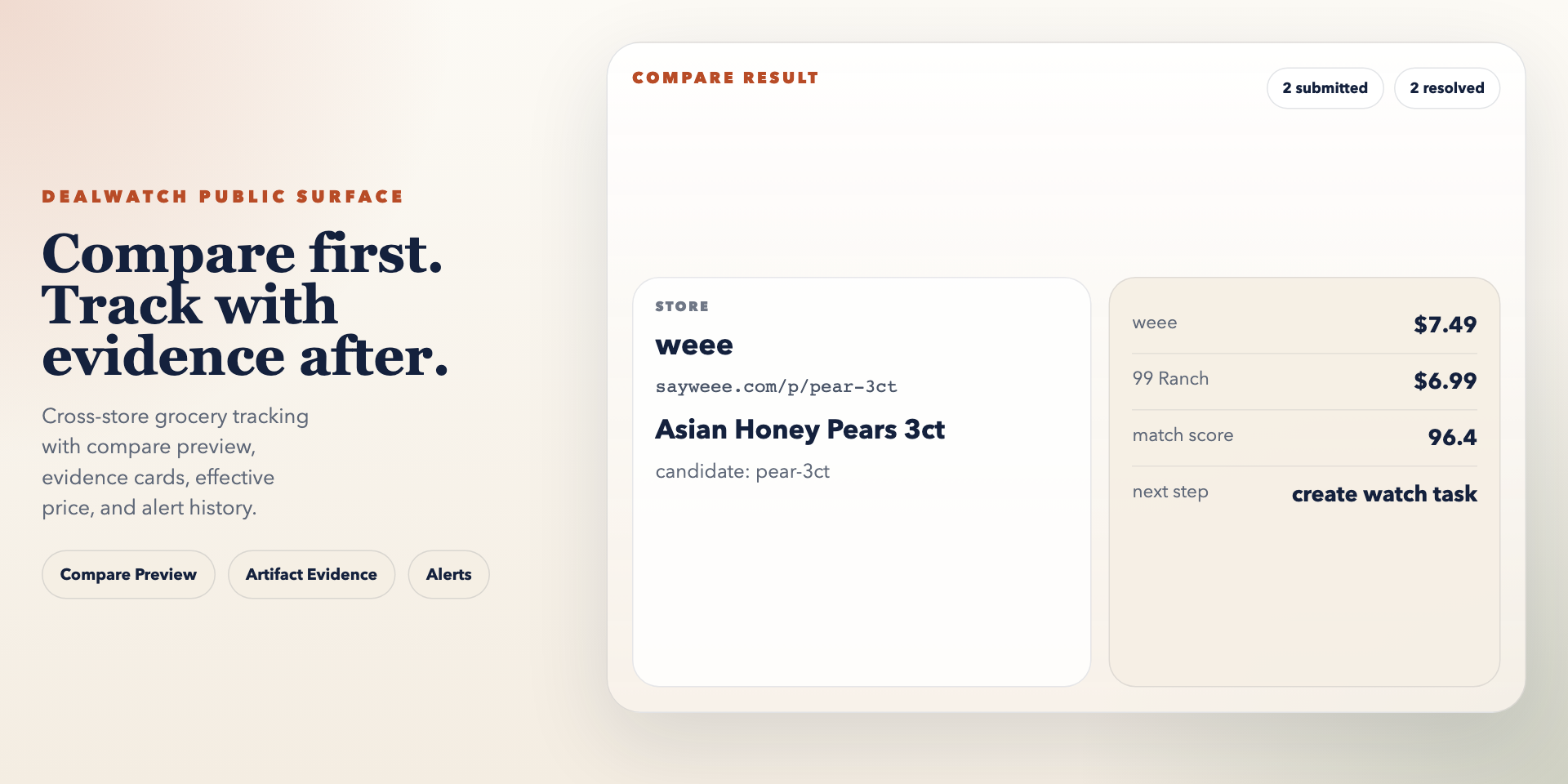
Use compare_preview before assuming any grocery URL deserves durable watch state.
These clients consume DealWatch truth. They are not the runtime base that DealWatch runs on.
| Client | Prompt starter | Skill card | Safe first flow |
|---|---|---|---|
| Claude Code | docs/integrations/prompts/claude-code-starter.md |
docs/integrations/skills/claude-code-readonly-builder-skill.md |
get_runtime_readiness -> get_builder_starter_pack -> compare_preview |
| Codex | docs/integrations/prompts/codex-starter.md |
docs/integrations/skills/codex-readonly-builder-skill.md |
get_runtime_readiness -> get_builder_starter_pack -> compare_preview |
| OpenHands | docs/integrations/prompts/openhands-starter.md |
docs/integrations/skills/openhands-readonly-builder-skill.md |
get_runtime_readiness -> get_builder_starter_pack -> compare_preview |
| OpenCode | docs/integrations/prompts/opencode-starter.md |
docs/integrations/skills/opencode-readonly-builder-skill.md |
get_runtime_readiness -> get_builder_starter_pack -> compare_preview |
| OpenClaw | docs/integrations/prompts/openclaw-starter.md |
docs/integrations/skills/openclaw-readonly-builder-skill.md |
get_runtime_readiness -> get_builder_starter_pack -> compare_preview |
GitHub Pages now also serves static JSON mirrors for the client starters, builder starter pack, and the full all-clients config bundle, so a machine reader can study the repo-owned contract before starting the local runtime.
These static mirrors are public proof assets for prompt starters, skill cards, starter maps, and all-clients payloads; they are not a hosted runtime or a write-capable control plane.
The public builders surface now also ships a static JSON catalog that mirrors the repo-owned client map without pretending the runtime itself is hosted.
Use it when an agent needs prompt, skill, recipe, and example links in one read before starting the local runtime.
Claude Code, Codex, OpenHands, OpenCode, and OpenClaw now all have copyable local-config examples here, but they still sit on top of the same read-only DealWatch contract.
| Client | Recipe | Example | Source | Syntax status |
|---|---|---|---|---|
| Claude Code | docs/integrations/recipes/claude-code.md |
Example file | Official docs | Official |
| Codex | docs/integrations/recipes/codex.md |
Example file | Official docs | Official |
| OpenHands | docs/integrations/recipes/openhands.md |
Example file | Official docs | Official |
| OpenCode | docs/integrations/recipes/opencode.md |
Example file | Official docs | Official |
| OpenClaw | docs/integrations/recipes/openclaw.md |
Example file | Official docs | Official |
Need a machine-readable handoff? The same builder page now points to both per-client and all-clients config export surfaces for CLI, HTTP, and MCP consumers.
Verified wrapper syntax now points back to the same repo-owned builder pack and local-first contract, but it still does not prove that every host listing is accepted, that a hosted control plane exists, or that write-side MCP is available.
Once the read-only route is clear, this frontdoor also exposes repo-owned builder-pack docs, native bundle candidates, listing-prep inputs, and crawlable machine entrypoints that stay tied back to the same local runtime contract.
Use the builder pack, prompt starters, skill cards, config recipes, and local config exports as the repo-owned frontdesk for every current DealWatch builder client.
Claude Code and Codex now also have repo-owned native bundle artifacts in the shared builder pack. OpenHands `#151` is closed and unmerged, `#152` is the retired predecessor, OpenCode remains an ecosystem-listing candidate, and OpenClaw still lacks fresh public ClawHub listing proof.
Use the builders page, proof page, static mirrors, and social preview art as listing-prep inputs for future marketplace or ecosystem submissions. They are ready for copy review and screenshots, not proof that any listing is live.
Search crawlers and LLM readers can now follow builders.html, llms.txt, sitemap.xml, feed.xml, and robots.txt as the same crawlable frontdoor into the route map.
These are builder-pack, native-bundle, and listing-prep materials layered behind the honest read-only route. Published marketplace listings and hosted control planes still remain outside this first slice.
A good builder frontdoor says both what to open next and what not to assume yet, so the page does not quietly turn into plugin theater.
DealWatch now ships repo-owned builder-pack materials for every client, native bundle candidates for Claude Code and Codex, and listing-prep inputs for the broader ecosystem. Some public proof is already live (PyPI and the Official MCP Registry), while OpenClaw still lacks fresh public ClawHub listing proof, OpenHands is closed and unmerged, MCP.so is still not publicly accepted, and the Chrome companion remains not published.
These builder paths are local-first. They do not prove a hosted remote control plane is live today.
The current builder surface is read-only-first. Maintenance, cleanup, owner bootstrap, and maintainer-only browser debug commands stay outside the builder promise.
DealWatch now ships a local Compare Preview recommendation slice, but builder surfaces still do not expose autonomous or builder-facing buy / wait recommendation support.