Is CortexPilot an official Codex or Claude Code plugin?
CortexPilot currently works with Codex and Claude Code workflows through Workflow Cases, Proof & Replay, read-only MCP, repo-owned skills, and builder entrypoints.
CortexPilot is for teams that need more than “the agent replied.” Route Codex- and Claude Code-style governed work through one command tower, keep every workflow case reviewable, and attach MCP-readable proof plus replay to the same operating record. The same front door also speaks to AI ops and platform teams that need a shared operator view instead of scattered agent logs.
Current boundary: the public surface is still a repo/demo control plane, not a hosted operator product, and the shipped MCP surface remains read-only.
Using Codex, Claude Code, OpenClaw, skills, or builders and not sure which door to open first? Start with the compatibility matrix. Need release notes, the repo home, or the docs map instead? Open the release page, the repository, the docs map or runtime topology.
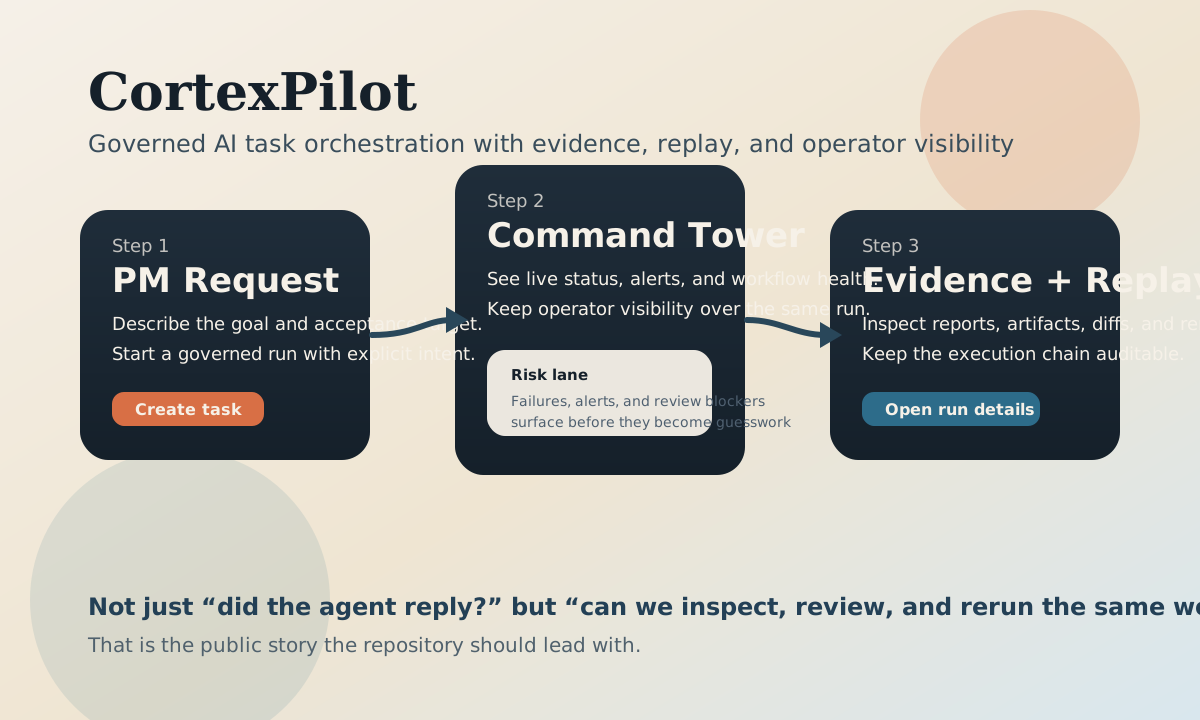
The public story should be simple: send one request, watch it move through Command Tower, confirm the Workflow Case, then inspect Proof & Replay.
CortexPilot currently works with Codex and Claude Code workflows through Workflow Cases, Proof & Replay, read-only MCP, repo-owned skills, and builder entrypoints.
CortexPilot's current public MCP contract is read-only, and write-capable mutation remains outside the public promise.
OpenClaw stays in the adjacent coding-agent layer. New teams should use the compatibility matrix, integration guide, and repo-owned skills path before implying a shipped native plugin.
Start with the compatibility matrix if the main question is which adoption path fits your stack. Then choose read-only MCP, skills, builders, or the first success path based on the real job.
New here? Use this as the only decision layer on the homepage. Let the deeper pages carry the detail once you know which door fits the job.
Start with the public first-run cases if you want to see a governed workflow, a case record, and replayable proof before you read package internals.
Start here if your main question is “I use Codex, Claude Code, OpenClaw, skills, or builders. Which CortexPilot surface should I open first?”
Start with the read-only MCP quickstart if you want the shortest truthful map of what external tools can inspect today.
Start with the integration guide if you need the truthful answer to how Codex, Claude Code, and OpenClaw can use CortexPilot today without fake official-plugin claims.
Start with the API and builder quickstarts if you want OpenAPI, contract-facing types, thin client helpers, and the shared frontend substrate.
Need the repo-owned playbook layer? Open the skills quickstart. Need the broader ecosystem framing? Open the ecosystem map. Need the operator-layer overview? Open AI + MCP + API surfaces.
Watch governed agents, MCP tools, queue state, and live operator signals from one surface.
Keep the request, queue, verdict, linked runs, and operating context attached to one case record.
Inspect failures, compare reruns, and keep the execution chain auditable before you trust the outcome.
Prompt 4 now adds two ecosystem-facing layers on top of this spine: a read-only MCP server for structured control-plane reads, and an AI operator brief that explains current run state without creating a second truth source.
Current boundary: MCP is read-only only, and CortexPilot is not a hosted operator product today. Write-capable MCP remains gated, and `cortexpilot.ai` should not be treated as a live hosted front door.
This file is the tracked source for the live GitHub Pages landing surface. The main calls to action intentionally point to stable public Pages and GitHub URLs so the repo, releases, and docs map stay verifiable. The host-compatible quickstart stays:
npm run bootstrap:hostCORTEXPILOT_HOST_COMPAT=1 bash scripts/test_quick.sh --no-relatednpm run dashboard:dev
Official first public path: start with news_digest if you want the smallest release-proven
proof loop, then use topic_brief and page_brief as public showcase expansions.
Best for the fastest proof-oriented first run with one topic, a few domains, and a short time window.
Proof state: official public baseline.
Best for a bounded topic brief when you want search-backed evidence without broadening scope.
Proof state: public showcase, not yet equally release-proven.
Best for a single URL with browser-backed evidence and a read-only workflow case wrapper.
Proof state: public showcase, browser-backed path.
See the public distribution loop in the use-case and share-ready asset guide.